

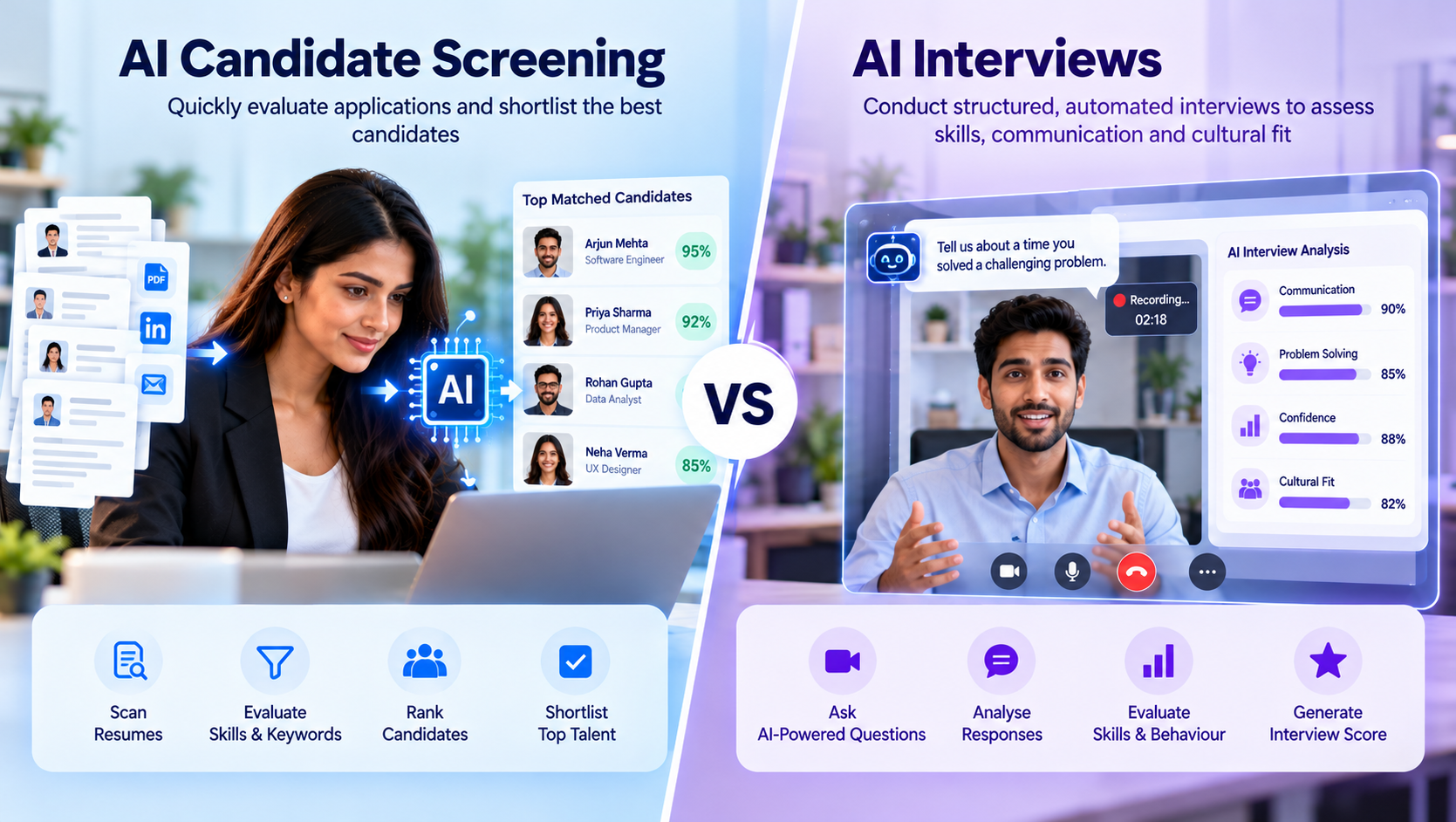
AI has proven useful in various parts of the hiring process. However, AI applicant screening and AI interviews are distinct.
Candidate screening primarily focuses on existing information, such as a resume or job application. An AI interview speaks directly to the candidate, asking questions and gathering new information about their experience, communication, thinking, and skills.
Both can be useful. The key is knowing when to use each.
How Does AI Candidate Screening Work?
Typically, AI candidate screening begins at the beginning of the hiring process. It filters applications and helps recruiters find suitable candidates.
This can save a lot of time when a company gets hundreds of applications for one position.
Reviews Existing Candidate Information
The screening system filters out resumes and applications. Can review for skills, experience, education, certification, and other specified requirements for the job.
It can then rank applications or candidates according to the criteria the recruiter provides. The recruiter can start with fewer resumes that more closely match the job requirements, rather than hundreds.
Helps Reduce Large Applicant Pools
Reading every resume manually is not always practical, especially for jobs that get a lot of applications.
AI screening can handle much of that first pass. It can remove applications that clearly don’t meet basic requirements, leaving recruiters with a more manageable list. This is where screening can save recruiters a good amount of time.
Works Best as an Initial Filter
One important limitation, though. A resume can tell you where someone has worked and what skills or qualifications they have. It cannot really tell you how that person speaks, handles pressure, approaches a problem, or reacts to a situation.
So AI screening works best as a first filter. Don’t treat it as the final answer on whether someone should be hired.
How Are AI Interviews Different From Candidate Screening?
AI interviews work differently because they collect information that was not already in the application. The candidate answers questions, and the hiring team can then review their responses.
Collects New Candidate Information
An AI interview can cover many areas, depending on the role. It may ask about communication, past work, technical knowledge, motivation, behavior, problem-solving, or how someone would deal with a particular situation. Some AI interviews use the same questions for every candidate. Others can change the next question depending on what the candidate said earlier.
Evaluates Candidates Beyond the Resume
Take a simple example. A resume might say that a candidate managed customers or led a project. That’s useful, but it does not tell you much about how they actually handled the work.
An interview can ask what the problem was, what the candidate did, and what happened after that. Now the recruiter has more than a resume line to review.
Supports First-Round Interview Automation
First-round interviews can take up a lot of recruiter time. Recruiters may have to ask the same basic questions to dozens of people.
AI interviews can handle that initial round. Candidates can answer questions remotely, and recruiters can review responses, reports, or scorecards later.
This does not mean the recruiter disappears from the process. Someone still needs to look at the results and make the final call.
Conclusion
AI candidate screening answers a fairly basic question: Who should we look at more closely? An AI interview helps answer the next one: What else should we know about these candidates?
Using both can make early hiring easier, especially when you have lots of applicants. But the final decision still needs human judgment.
Harjai.AI brings these hiring stages together through its AI Recruiter, AI Interviewer, AI Assessments, and Agentic ATS. Our system combines resume screening, structured interviews, assessments, scheduling, proctoring, smart reports, and recruiter review into a single hiring workflow.

Rohan Kapoor writes about AI recruitment, hiring automation, candidate assessments, interview technology, and modern HR trends. His content helps recruiters, HR teams, and business leaders understand how AI-powered tools can streamline hiring processes, improve candidate evaluation, and support smarter recruitment decisions.