

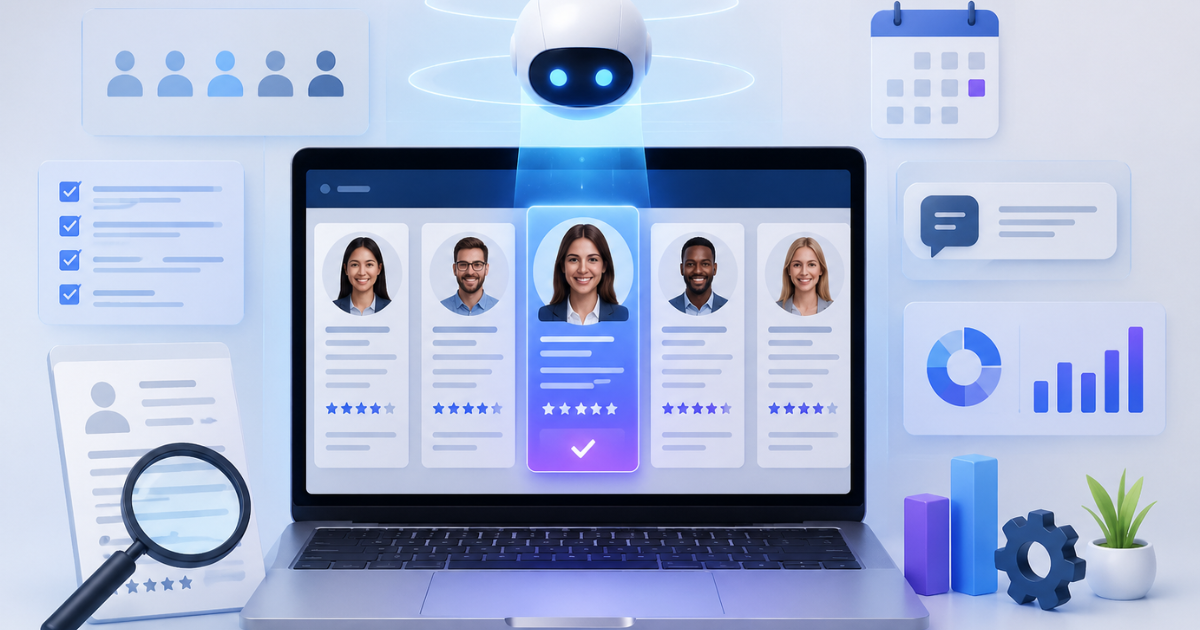
AI now changes how companies find and hire people. Tools handle resume screening, candidate sourcing, interview scheduling, and skill testing. Due to the challenges in managing the hiring process manually, companies are increasingly relying on AI recruitment software.
But when hundreds of applications are received and positions need to be filled immediately, companies turn to AI tools to quickly hire the best candidates.
Yet adding AI to hiring does not mean results get better right away. A lot of companies bring in these tools without a solid plan, checks in place, or a way to match them to their existing steps. As a result, they end up with unhappy candidates, unfair results, shaky assessments, and too much trust in the machines.
The true power of AI recruitment software comes from smart setup and ongoing control.
What is AI Recruitment Software?
AI recruitment software is a tool designed to help with various aspects of recruitment. These tools are used to sort resumes, schedule interviews, administer assessments, and keep applicants posted on application updates. However, AI recruitment software is not designed to completely take over the roles of recruiters but to cut down the time spent in the recruitment process.
Current AI recruitment systems usually offer the following:
- AI candidate matching
- Automated resume screening
- AI interview systems
- Hiring analytics
- Skill assessments
- Candidate communication automation
The aim remains to raise recruitment speed, handle larger numbers, and keep hiring steady.
What Makes AI Recruitment Software the Best Choice for Companies?
The hiring process nowadays is entirely data-driven and moves at a rapid pace. Businesses get flooded with applications as they try to shorten hiring wait times and raise the quality of the people they hire. This explains why AI recruitment software is among the strongest hiring options for today’s organizations. It lets them hand off routine recruitment jobs while improving speed, growth capacity, and daily workflow.
Faster Candidate Screening and Shortlisting
AI recruitment systems review large stacks of resumes in just minutes and let recruiters spot good matches much sooner than they could by hand. This cuts waiting periods in hiring and increases how much recruiters get done.
Better Hiring Scalability
Organizations handling several hiring at once often run into trouble coordinating interviews. With more hires to manage, companies require a solution that lets them handle more applicants without adding more HR staff. AI tools streamline growth and help maintain organized recruitment operations.
Improved Recruitment Efficiency
AI recruitment tools handle repetitive jobs, saving time for HRs. They take over tasks such as conducting interviews, screening candidates, or sending follow-up emails. This helps hiring departments spend more time on the right thing—the job candidate evaluation—and less on administrative tasks during the day.
Stronger Candidate Matching Accuracy
Smart systems with artificial intelligence analyze a candidate’s skills, prior work experience, and qualifications, as well as job requirements, to improve the overall quality of hires.
Better Candidate Experience
Candidates also see the difference when the recruitment processes become streamlined and organized. Quick responses, hassle-free booking processes, frequent updates, and streamlined application experiences positively impact applicants. This can boost the employer brand over time and, potentially, employee retention.
Data-Driven Hiring Decisions
Another benefit of AI recruiting solutions is access to hiring data and performance insights. Recruiters can check the speed of hiring, the quality, and the efficiency of the whole process.
Reduces Time-to-Hire
Long hiring waits often mean good candidates choose other offers. AI-powered recruitment systems streamline the process and help businesses fill positions more quickly while still ensuring quality.
Supports Continuous Hiring Optimization
AI recruitment tools continue to adapt and evolve based on past trends, outcomes, and metrics to continually improve performance.
Common Mistakes Companies Make When Using AI Hiring Software
Failing to have a strong rollout plan shortens the actual positive impact of implementing AI around recruitment. Avoiding these mistakes will help companies set up better and more consistent hiring.
Depending Completely on AI Without Human Oversight
One major error companies commit is letting AI systems make hiring decisions without proper oversight. The need for humans in the hiring process is still there, as AI can help in screening candidates but can not check personality, communication skills, leadership abilities, workplace performance, and many other factors like these.
Using Poor Quality or Biased Training Data
AI systems perform only as well as the information they are fed. When past recruitment data reflects old biases or weak patterns, the tool may continue to reproduce those issues when selecting candidates. This leads to unfair selection results.
Ignoring Candidate Experience
Lots of companies put all their attention on automation speed and overlook how candidates get treated. Badly built AI interviews, slow replies, stiff messages, or tricky application steps can annoy people and hurt the company’s image. Candidate experience continues to play a big role in recruitment.
Expecting AI to Fully Replace Recruiters
AI recruitment tools exist to help recruiters, not take over the whole job. Organizations that rely on AI to run hiring on its own often struggle to build relationships, make final calls, and judge talent more deeply. Human input stays necessary.
Implementing AI Without Clear Hiring Goals
Some organizations grab ai recruitment software just because everyone else talks about it, without first spelling out their hiring problems, targets, or what they need from daily operations. Tools without a plan usually create messy processes instead of fixing recruitment.
Ignoring Transparency and Explainability
Both the candidates and the hiring teams want a clear explanation behind the response of AI. Companies that employ hard-to-explain AI recruitment systems sometimes have to face legal problems, confusion inside their own teams and trust issue from the candidates’ side. Clear hiring steps build trust.
Overlooking Compliance and Data Security
Recruitment systems manage private candidate details, interview notes, and personal files. Loose protection methods can bring legal trouble and day-to-day risks for businesses running AI hiring platforms. Solid rules and strong security stay essential.
Using Generic AI Systems for Specialized Hiring
Various fields and positions call for different ways to judge people. Standard AI recruitment systems might miss the mark on technical skills, leadership needs, or industry-specific demands. Tailoring the system raises accuracy.
Failing to Continuously Monitor AI Performance
AI hiring systems demand regular checks, tests, and tweaks. Certain companies think the tool will work fine forever after launch and skip checking accuracy, bias, or the quality of people coming in. AI systems call for steady updates.
How Companies Can Use AI Recruitment Software More Effectively
Companies see stronger results from AI hiring only when they use it according to a plan, rather than leaving everything on full automation.
Combine AI with Human Decision-Making
Top hiring setups mix machine speed with recruiter knowledge. AI should handle initial checks and tests, while people make final decisions and handle personal contact.
Use Structured and Diverse Hiring Data
Always train the model with balanced, accurate, and diverse recruitment data to reduce bias and judge candidates more rigorously.
Prioritize Candidate Experience
Clear messages, quick scheduling, open evaluations, and simple application steps boost both hiring speed and the company’s reputation.
Regularly Audit AI Recruitment Systems
Organizations need to continue examining hiring accuracy, fairness, key metrics, and candidate feedback to improve AI recruitment.
Conclusion
AI is changing today’s recruitment, yet tools alone cannot fix faulty hiring methods. Companies that lean only on automation often add fresh problems rather than fix the old ones. The true payoff from ai recruitment software rests on careful rollout, human checks, open decision steps, and steady tuning. Organizations that blend automation with thoughtful hiring practices end up with stronger recruitment setups and happier candidates.
This is where Harjai AI comes into play. Harjai AI offers state-of-the-art AI-powered recruitment solutions that automate sourcing, screening, interviewing, and applicant evaluation while maintaining structured hiring workflows and ensuring scalable, effective recruitment. We bring together an AI Recruiter, an AI Interviewer, and smart hiring automation systems to future-proof your hiring without compromising quality or control.