

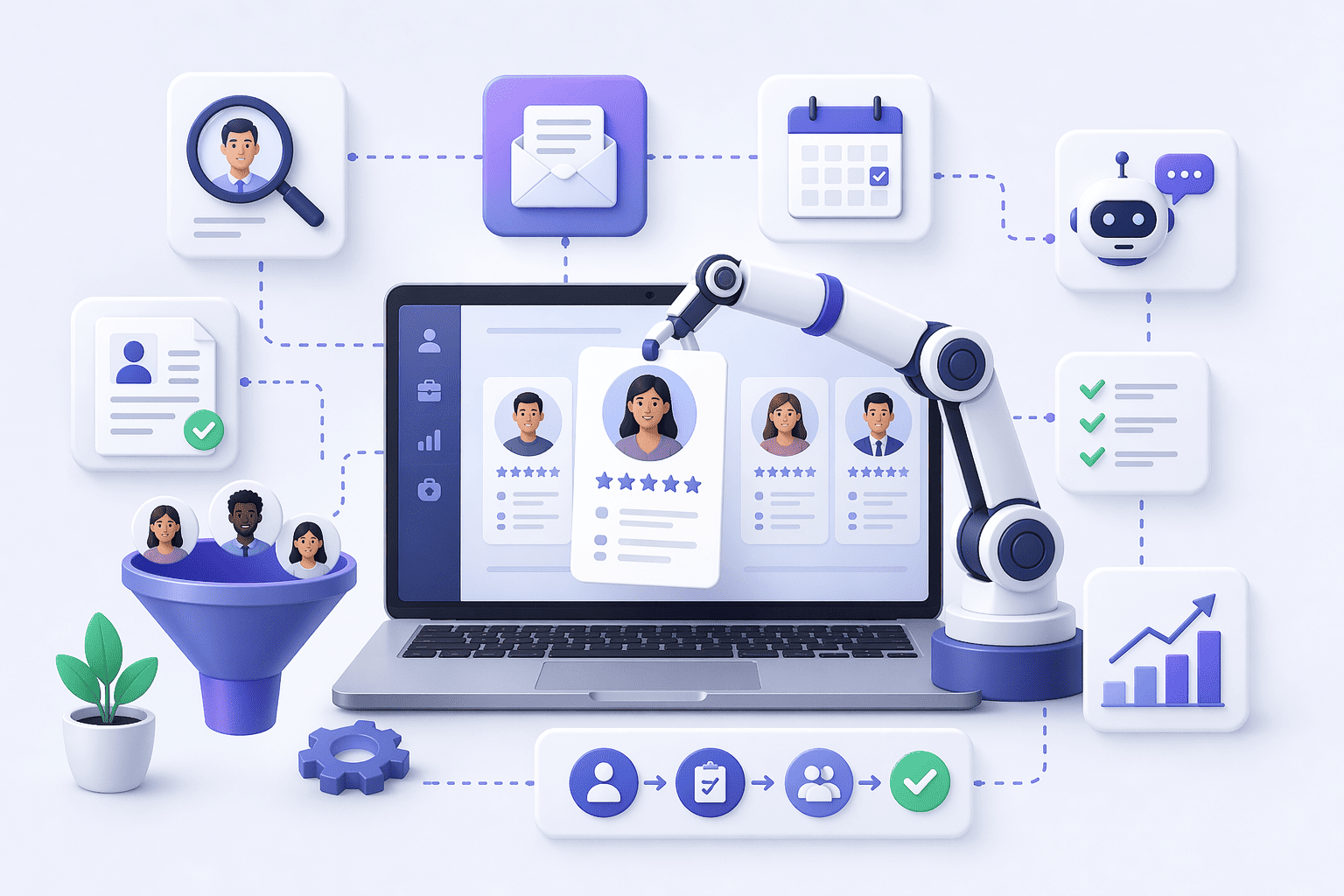
The failure of hiring today does not lie in the fact that companies do not have candidates but in the fact that the entire process is inefficient. Recruiters are left to sift through hundreds of resumes, schedule interviews, and chase individuals down to respond, and they still cannot make decisions fast enough. By the time they push things ahead, the best people have usually moved on to other offers.
The core problem comes down to too much manual work rather than a lack of trying. Recruitment automation steps in to fix that. By implementing AI-powered solutions and an Automated interview platform, the company can eliminate repetitive, automated tasks, streamline the hiring process, and make more effective decisions.
The purpose of recruiting automation is not to replace the recruiter. It just gives them the space to focus on the most important aspect of all: choosing the right individuals for the team.
What is Recruitment Automation?
Recruitment automation refers to using AI and other technologies to streamline hiring processes, including candidate search, application submission, time booking, and suitability checks. It turns slow manual steps into quicker processes guided by data.
Recruiters no longer waste hours on repetitive tasks. Automation handles the day-to-day operations so they can spend their energy on planning and making final calls.
What to Automate in Recruitment?
Recruitment is best done by selecting the appropriate parts to automate, rather than attempting to automate everything. Target the jobs that recur often, involve high volume, and follow clear steps that hold teams back. Tools such as an Automated interview platform make those parts quicker, more reliable, and simpler to grow with demand.
Job Posting and Distribution Across Channels
Instead of placing advertisements individually across various locations, automation posts the positions simultaneously on job boards, the company’s career pages, and social media. This exposes the role more widely, exposes it earlier, and maintains the wording everywhere.
Resume Screening and Initial Shortlisting
It is time-consuming, and the results are not equal when going through the hundreds of resumes manually. They automate the checking of the applications based on the necessary skills, background, and key terms, allowing recruiters to consider only the promising ones and spend much less time on the initial sorting.
Candidate Sourcing and Pipeline Building
Automation continues to search lapsed databases, past applicant records, and websites to maintain a steady list of potential talent on hand. You never construct each position; each time you see a new position, you construct it.
Interview Scheduling and Coordination
Sending emails back and forth to locate meeting times costs hours. Automated systems are used to check calendars, issue invitations, process changes, and remind everyone, keeping the schedule up to date without having to chase people all the time.
Pre-Screening Assessments and Evaluations
Conducting tests immediately would ensure that only qualified candidates are propelled forward.
- Skill-based tests
- Aptitude checks
- Role-specific evaluations
This step clears out mismatches early before any live interviews take place.
Structured Interviews via Automated Interview Platform
An Automated interview platform brings order to interviews. The set of questions is the same for all candidates, and the answers are scored in a standardized manner that reduces the impact of personal bias and saves the interviewer time.
Candidate Communication and Follow-Ups
Automation continues to send messages at designated times at every stage, both to confirm apps and to provide updates and reminders. Candidates remain interested, and a lesser number of them drop out in the process.
Offer Letter Generation and Onboarding Workflows
Once a person has taken up the position, automation takes care of the paperwork, prepares offer paperwork, and begins the onboarding process to make the transition into the company look well-structured and friendly.
What NOT to Automate in Recruitment
Automation brings speed and order, yet some parts of hiring still need people in charge. Relying too heavily on systems can hurt candidates’ perceptions of the company, weaken the quality of decisions, and lead to poor hires. The secret lies in understanding exactly where human input is necessary, even alongside an Automated interview platform.
Final Hiring Decisions Require Human Judgment
AI is good at shortlisting and simple scoring but lacks the subtleties, such as team chemistry, personal drive, or future development. The final call on who to bring in should always rest with the people to match the hire to the group’s needs and company aims.
Relationship Building with High-Value Candidates
Top candidates pick more than just the job title. They pick the people and the environment around them. Building trust, holding real conversations, and working through terms require direct human contact that automation simply cannot match.
Leadership and Strategic Role Hiring
Senior positions and leadership spots need close review that goes beyond numbers and scores. These options involve more macro-level thinking, leadership style, and general orientation, and thus require genuine human consideration and discussion.
Employer Branding and Candidate Experience
The first contact sets the tone. Automated notes can manage basic updates, but real conversations, particularly toward the end, need to come across as personal, warm, and true to the company image.
Complex Interview Conversations
Some jobs call for open discussions, quick problem-solving, and on-the-spot thinking. These talks lose their value if forced into a fixed format or handed over completely to automation.
Handling Sensitive Communication
Rejection of applicants, negotiation of offer details, or feedback must never be on autopilot. Such exchanges shape how people view the company and must be delivered with care and clarity.
Exception Handling and Unique Cases
Standard flows do not cover everyone. Applicants who have odd backgrounds, major career shifts or special cases require additional consideration and human judgment outside the automated rules.
Benefits of Recruitment Automation
Recruitment automation goes beyond making steps quicker. It solves the main slowdowns that drag hiring out. Done right, it raises accuracy, keeps results steady, and lifts the entire hiring outcome. With tools like an Automated interview platform, organizations shift from scattered manual work to clear, expandable systems.
Faster Time-to-Hire Without Process Bottlenecks
Automation clears out hold-ups in screening, booking, and updates. What took days to complete are now finished in seconds, and as such, recruitment agencies are accelerating the promotion of the good candidates before they are attracted by other companies.
Higher Quality of Hire Through Structured Evaluation
Automation applies the same standards to every applicant. Thanks to an Automated interview platform, each person faces the same criteria, leading to fairer reviews and stronger final decisions.
Reduced Operational Workload for Recruiters
Recruiters cut down hours lost to the same old tasks such as checking resumes, chasing replies, and fixing schedules. They gain space for important work like talking with candidates and deciding who fits best.
Improved Candidate Experience and Engagement
People get quick replies, regular updates, and cleaner interview steps. Smooth timing and well-ordered stages leave applicants with a better impression of the company and the process.
Scalable Hiring Without Increasing Team Size
Automation enables organizations to operate hundreds of applications without any hassle. The same dependable strategy applies when filling one or ten vacancies, as well as when filling a hundred vacancies, without increasing the recruitment staff.
Data-Driven Hiring Decisions
The instruments gather transparent data on candidates’ performance, hiring trends, and where the procedure is advancing or stalling. Firms are then able to make modifications based on actual figures rather than speculation.
Consistency Across the Hiring Process
Hiring done by hand often changes depending on who handles it or which team runs it. Automation keeps every stage uniform, with matching evaluations and steady results from start to finish.
Cost Efficiency in the Long Run
Less manual work, better accuracy, and fewer mistaken hires all add up. Over time, recruitment automation brings hiring expenses down and delivers stronger returns.
Conclusion
Many companies blame the hiring problem on a lack of good talent. Yet the real cause usually sits in slow, old-fashioned steps. Hand-done resume checks, loose interview formats, and late replies build waste that eats up time and misses chances.
This is the exact spot where we step in. At Harjai AI, we support companies in updating their hiring processes through smart automation and strong Automated interview platform options. We cover everything from AI-powered tests to organized interview reviews and flexible recruitment flows so decisions happen quicker, with more insight, and greater precision.