

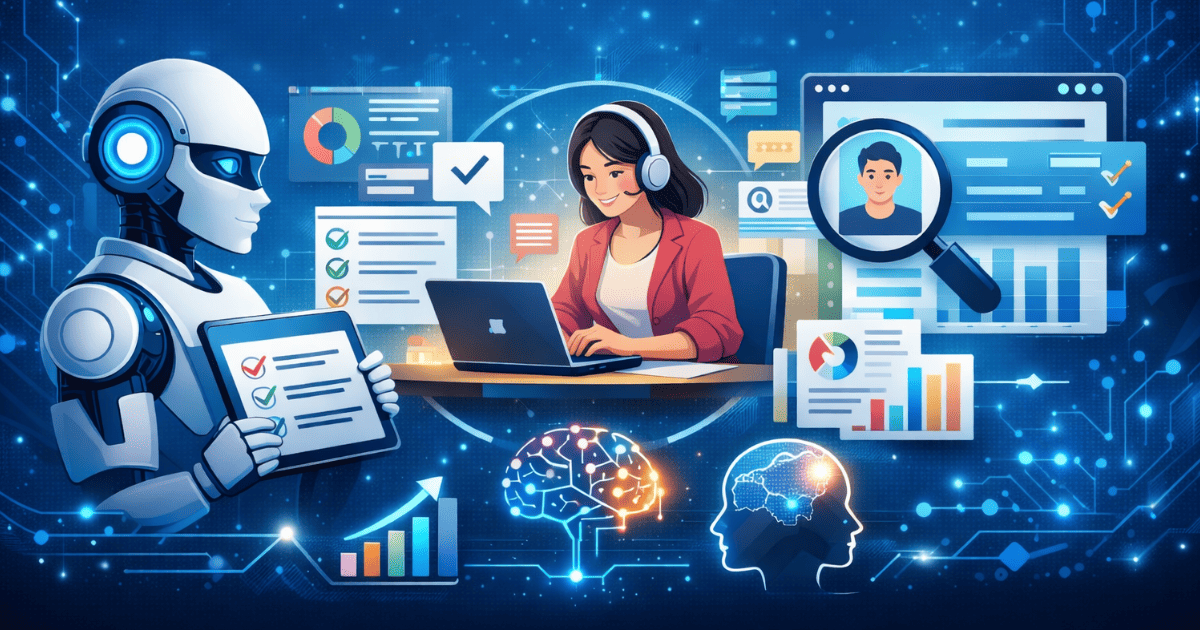
eLearning isn’t falling short because there’s not enough content. The real problem is with how we check what people actually learned. Traditional tests take forever to put together, the grading comes out uneven, and they often don’t show if someone really gets it or not. Teachers end up spending hours making questions and then manually checking responses, but still struggle to assess skills accurately.
That’s the spot where AI steps in and changes it. AI-generated assessments go beyond just speeding things up. They adjust the whole evaluation as it goes, handle larger groups, and actually use the data that comes in. You stop getting the same old fixed quiz for everyone. Instead, the questions shift depending on how the person is doing, what they click, and how they answer in the moment.
AI isn’t throwing out assessments. It’s just making them work better, faster, and actually useful.
What Are AI-Generated Assessments in eLearning?
AI-generated assessments are systems that use artificial intelligence to construct tests, administer them, and analyze the findings independently. They can generate questions, mark answers, and extract useful information without involving a person each time.
Compared to the old ways, these AI assessments pay attention to things like:
- Real-time evaluation
- Adaptive question generation
- Data-driven performance insights
They move things away from one-time tests and toward tracking learning as it happens.
10 Key Insights on AI-Generated Assessments and Evaluations
AI isn’t only tweaking assessments. It’s pretty much changing the whole way we measure, look at, and improve learning. No more waiting for exam results or getting feedback days later. These systems create something that keeps going, adjusts itself, and actually gives you useful information. Here are the main points that show what this shift does for eLearning.
1. Adaptive Testing Replaces One-Size-Fits-All Exams
Assessments generated by AI modify the level of difficulty of questions immediately, depending on the answer provided by the learner. If someone is doing well, they get tricky questions.
If not, it drops back to basics. This way, you get a better sense of their actual level instead of just a flat score that doesn’t mean much.
2. Instant Feedback Accelerates Learning Cycles
With regular tests, you usually wait a while before you hear anything back, and by then the moment has passed. AI gives feedback straight away. Students can observe what they did wrong and correct it while the information is still in their minds.
3. Continuous Evaluation Instead of Single Exams
AI lets you check progress all the way through the course, not just at the end with one big exam. You get a much clearer view of how someone is moving forward, and it takes some of the stress off those final tests.
4. Deeper Skill Analysis Beyond Correct Answers
It’s not only about right or wrong anymore. AI analyzes people’s responses, how they think, and what they are generally responding to. That provides a more complete picture of strengths and where work is yet to be done.
5. Automated Content Generation for Assessments
The AI can automatically put together quizzes, tests, and entire evaluation setups from the course material. It saves teachers a ton of time and keeps the quality pretty even across different sections.
6. Scalable Evaluation for Large Learning Environments
These systems can handle thousands of learners at once and remain accurate. That makes them really useful for large universities, online course platforms, or company training with many participants.
7. Reduced Human Bias in Grading
Since AI applies the same rules to all, you eliminate differences that creep in when people grade manually. It brings about more equality and uniformity.
8. Real-World Scenario-Based Testing
AI can set up situations that feel like actual work or life scenarios. Students must use their knowledge, rather than simply choose the correct answer out of the hat. That will make the test more relevant to what they will actually need later.
9. Data-Driven Insights for Better Learning Strategies
The reports generated by AI provide you with in-depth insights into learners’ progress. The teachers can identify areas of weakness that are prevalent, identify trends, and determine what needs to be changed in the teaching or course material.
10. Seamless Integration with Learning Platforms
These AI tools integrate with existing LMS platforms without much trouble. There is a smooth flow of information between the learning and testing sides, and therefore, everything does not seem separate.
Challenges of Traditional Assessments in eLearning
The old means of assessment were established for use in normal classroom settings, not in online learning, which is quite rapid and dynamic. Attempting to apply them to eLearning, you find yourself encountering issues of accuracy, working with larger groups, and maintaining interest among the individuals. These problems complicate the actual knowledge of what has been learned.
Delayed Feedback Slows Learning Progress
In the traditional setup, someone has to grade everything manually, so feedback takes time. By the time it reaches the learner, they’ve usually moved on, and the lesson doesn’t stick as well. Progress ends up slower than it should.
One-Size-Fits-All Evaluation Approach
Most ancient exams involve the same questions and format for each individual. Whether they are developed or not, it does not matter. This means that good students are not really challenged, and the weak students do not receive the necessary assistance.
Limited Insight into Actual Understanding
Traditional tests mostly focus on whether the answer was correct. They don’t tell you much about how the person thought through it or where the real confusion is. Finding actual gaps becomes guesswork.
High Dependency on Manual Effort
Everything from creating the test to giving it and then marking it falls on people. That adds to teachers’ workload and makes scaling up nearly impossible when you have hundreds or thousands of learners.
Inconsistency and Human Bias in Evaluation
Different teachers grade differently. Some are stricter, some more lenient, especially with written answers. That brings in personal bias and makes the final scores less reliable.
Poor Scalability for Large Learner Bases
Handling big groups with traditional methods gets messy fast. Marking thousands of papers or submissions takes ages, and mistakes start happening.
Lack of Real-Time Performance Tracking
Progress is only reviewed at specific stages, such as mid-term or final. You can never intervene at an early stage because there is no consistent perspective on how an individual is improving or when they are beginning to fall.
Limited Engagement and Interactivity
Plain quizzes and fixed exams quickly become boring. Without anything that changes or reacts, learners lose interest, and the assessment doesn’t help as much as it could.
Inability to Simulate Real-World Scenarios
Most traditional tests stick to theory and facts. They do not allow individuals to train on applying knowledge in scenarios that seem real, which is what really counts now.
Difficulty in Updating and Customizing Assessments
You have to open it and edit everything manually if you need to change anything or add new content. It is time-consuming and difficult to keep up with fast-paced courses.
Conclusion
Many eLearning platforms pour energy into the content but leave the evaluation part weak. Slow testing, inconsistent grading, and not enough real insights end up limiting how well the whole program works. Good content alone isn’t enough if you can’t tell whether people are actually learning.
This is the area where platforms like Harjai AI are making a difference. It is an AI assessment software that allows organizations to automate tests, conduct adaptive checks, and extract clear performance reports despite high volumes of users.
Whether it is AI-driven interviews, hands-on skill tests, or automatic scoring, our IT solutions for eLearning transform how learning and evaluation work together.